

Overview:
In what marks a strategic shift in policy direction, ERA said it will now prioritize energy projects that contribute to grid flexibility and resilience. This includes developments that integrate energy storage systems or hybrid models combining renewables with base-load technologies.
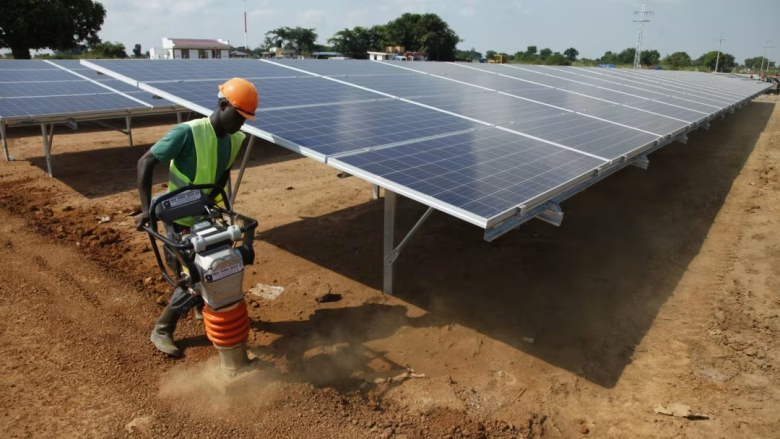
KAMPALA – Uganda’s Electricity Regulatory Authority (ERA) has imposed an immediate suspension on the permitting and licensing of all new grid-connected solar and wind projects, citing mounting concerns over the stability of the national electricity grid.
The decision, formalized in a public notice dated October 22, 2025, and issued under Section 9(1) of the Electricity Act, Cap 157, takes effect immediately. ERA said the pause is a proactive step to ensure that the grid can continue to operate reliably amid the growing share of variable renewable energy (VRE) sources such as solar and wind.
While Uganda has made significant progress in expanding renewable energy generation, ERA warned that the grid’s limited capacity to absorb intermittent power could pose a risk to system stability if not managed through proper technical interventions. “The suspension is necessary to preserve grid reliability and safeguard power quality as the country scales up renewable energy,” the regulator noted in the announcement.
The moratorium applies exclusively to new grid-connected projects. Existing licenses and permits, as well as applications already under review before the notice, will proceed as planned. Off-grid and standalone renewable projects — which play a critical role in rural electrification — remain unaffected.
In what marks a strategic shift in policy direction, ERA said it will now prioritize energy projects that contribute to grid flexibility and resilience. This includes developments that integrate energy storage systems or hybrid models combining renewables with base-load technologies.
“Future licensing will favor projects that include storage components or hybrid configurations capable of providing firm power,” the regulator stated, underscoring that such technologies are essential for stabilizing frequency and voltage fluctuations caused by VRE variability.
ERA further emphasized that Uganda’s energy transition must proceed in tandem with reliable base-load generation. To that end, the regulator reaffirmed support for the continued development of large hydropower, geothermal, and emerging nuclear projects — all considered critical to maintaining consistent supply and balancing renewable integration.
The suspension comes as the Uganda Electricity Transmission Company Limited (UETCL), the national system operator, conducts a Grid Stability Study to evaluate the system’s current ability to accommodate additional renewable energy capacity. The study will assess technical constraints, dispatch flexibility, and the need for storage or ancillary services to stabilize the grid.
Preliminary findings are expected to inform new regulatory and investment guidelines. ERA indicated that final recommendations and policy adjustments will be published in the first quarter of 2026, after which the suspension may be reviewed.
Investor Impact and Market Reaction
The decision is expected to reshape Uganda’s renewable energy investment landscape. Developers pursuing new projects will need to reconfigure their designs to include battery storage or hybrid generation systems, significantly increasing project complexity and capital expenditure.
Industry experts describe the move as both a challenge and a sign of market maturity. “This is a pivotal moment for Uganda’s energy sector,” said one Kampala-based energy analyst. “The focus is shifting from adding megawatts at any cost to ensuring that every additional megawatt enhances the reliability and stability of the grid.”
For investors, the new framework could increase upfront costs but also create opportunities in advanced technologies such as battery storage, smart grids, and hybrid power systems. These solutions, once seen as premium, are increasingly becoming prerequisites for sustainable energy integration.
Uganda’s installed power capacity currently stands at just over 1,400 megawatts, dominated by hydropower. However, in recent years, grid-connected solar and wind projects have expanded rapidly under the country’s renewable energy feed-in tariff (REFiT) program. ERA’s latest move underscores the regulator’s intent to balance this growth with technical prudence, ensuring that the national grid remains stable as renewable penetration rises.
As Uganda works toward universal access to electricity and a cleaner energy mix, the current pause may prove to be a necessary recalibration — one that prioritizes quality, reliability, and grid modernization over short-term capacity additions.